

How to Choose a Funky Lamp in Australia That's Actually Well Made
If you want a funky lamp in Australia that lasts longer than one trend cycle, the trick is simple: buy from a maker who tells you exactly what the lamp is made of, and make sure that material is matched to a cool, low heat bulb. Get those two things right and a quirky lamp becomes a piece you keep for years, not a novelty you quietly retire.
I make 3D printed lamps in a small Melbourne studio, so I spend my days with the boring practical details behind the pretty photos. This is the guide I wish more lighting shops would write. It covers what funky lamps are really made from, the one bulb mistake that shortens their life, what Australian electrical rules mean for you, and why made to order changes what you are actually buying.
What makes a lamp "funky" in the first place
Funky, quirky, unusual, unique. People search for all of these, and they tend to mean the same thing: a lamp with a bit of personality, not the same brushed metal stick everyone else has. Sculptural shapes, soft organic curves, a colour that does something to the room. The kind of lamp a guest asks about before they sit down.
The catch with a lot of unusual lamps sold here is that the look is the whole story. A striking shape gets imported in bulk, photographed well, and that is where the thought stops. There is nothing on the page about what it is made from or how to look after it. So before we get to the fun part, let me show you how to read past the photo.
Start with the material, because it decides everything else
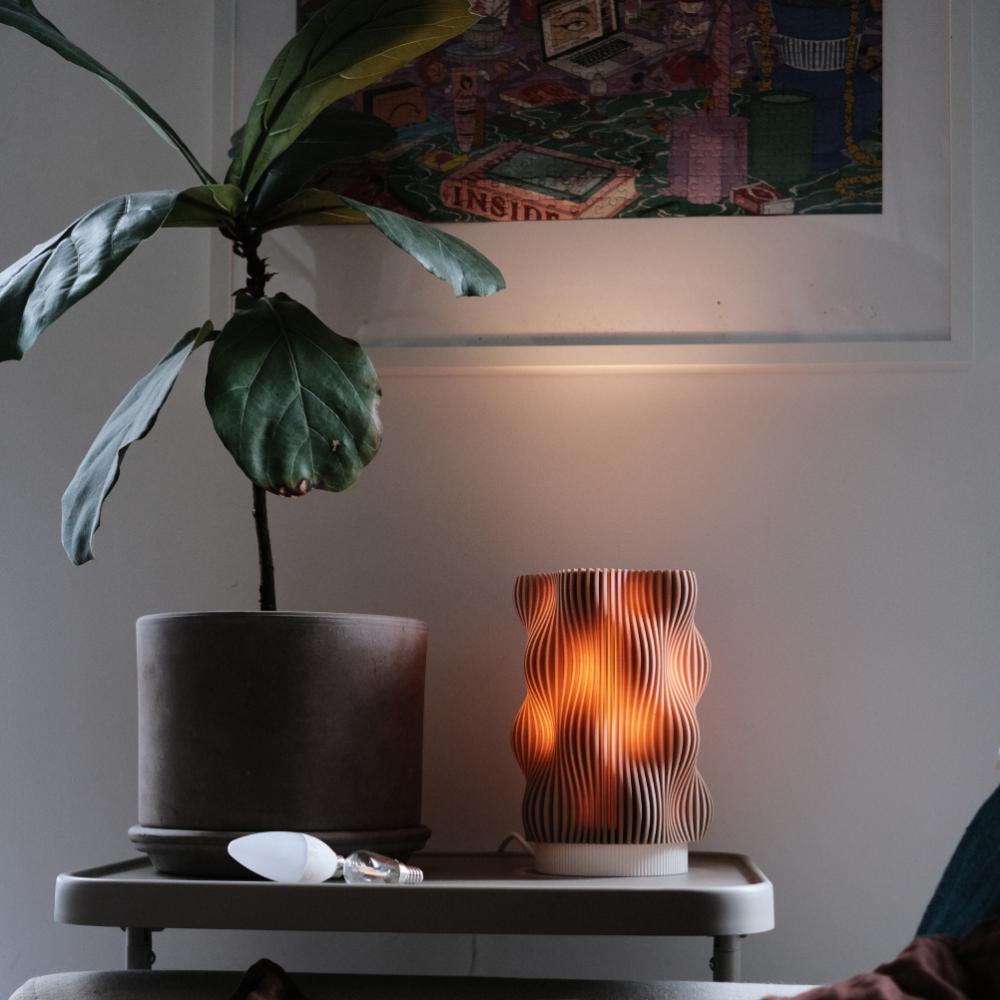
Most 3D printed lamps, including ours, use PLA. It is a plant based plastic made from corn starch, and it is what gives a printed shade those fine visible layers that catch the light. Our Big Yellow Lamp is a corn starch PLA shade on a weighted nickel plated base, and the Bubble Lamp is PLA right through. I tell you this on the product page on purpose, because the material is the single most useful thing you can know before you buy.
PLA has one quirk worth understanding. It is lovely to print and it holds crisp detail, but it softens at a fairly low temperature, somewhere around 55 to 60 degrees. In normal room conditions that never comes up. It only matters because of the bulb you screw in, which brings us to the mistake I see most often.
The bulb is the part people get wrong
An old style incandescent or halogen bulb throws off a surprising amount of heat. Put one inside a printed PLA shade for a few hours and you are slowly cooking the very thing that makes the lamp special. The fix is easy and it is also just the smarter choice for your power bill: use an LED bulb. LEDs run cool to the touch and use a fraction of the energy, which the Australian Government's own lighting guidance spells out clearly.
Our lamps take a standard E27 screw bulb, and some, like the Big Yellow, ship with the right warm LED already in the box. If you are buying any 3D printed or fabric shaded lamp, ask the seller what bulb it is rated for. A maker who knows their product will answer in a sentence. A drop shipper usually cannot.
Is a 3D printed lamp safe to plug in here?
This is the question almost no funky lamp listicle answers, and it is the one that actually matters. Any mains powered lamp sold in Australia is electrical equipment, and it has to meet the Electrical Equipment Safety System, known as the EESS. Equipment that complies carries the Regulatory Compliance Mark, the little RCM tick you will find on the underside of a base or on the plug. You can read about how the scheme works on the official EESS website.
What that means for you as a shopper is straightforward. A lamp wired and supplied by an Australian business is built to Australian plug and safety requirements from the start. A no name lamp shipped direct from overseas often is not, and if anything goes wrong there is nobody local standing behind it. When you buy something that lives plugged in by your bed or your reading chair, that is not a detail to wave away. Buying local is not only the warm fuzzy choice. It is the safer one.
What "made to order" really gives you
A lot of our lamps are printed to order, here in Melbourne, after you place it. That has a few real consequences worth knowing before you buy, both good and honest.
The good part: very little waste, no warehouse full of unsold stock, and a finish that is genuinely a little bit yours. Because each shade is printed individually, no two are perfectly identical. You might catch a tiny variation in a layer or the seam where a print starts. We even sell a Not Perfect range built around exactly that, the pieces with a small gap or a colour shift that we would rather pass on at a lower price than throw away. To me those marks are the opposite of a flaw. They are proof a person and a printer made the thing, rather than a mould stamping out ten thousand identical copies.
The honest part: made to order takes a little longer than pulling a box off a shelf, so you are trading next day delivery for something built for you. If you need a lamp tonight, a made to order piece is not it. If you are happy to wait a few days for something distinctive and well built, it is exactly it.
A quick word on outdoors
People ask whether they can put a printed lamp on a covered patio. My honest answer is no, keep PLA lamps indoors. PLA does not love long sun exposure or heat, and these are designed as indoor mains lamps, not weatherproof outdoor fittings. If you want something for outside, look for a fitting rated for outdoor use with a sealed, weather rated design, which is a different product entirely.
So, how do you actually choose one?
Run any funky lamp you are eyeing past four quick questions. Does the listing tell you what it is made from? Does it say what bulb to use, and is that an LED? Is it supplied by a business that builds to Australian electrical rules? And do you actually love the shape enough to keep looking at it for years? If you get four yes answers, buy with confidence.
If you want a shortcut, the whole of our Lamps and Lighting range is built to pass that test: corn starch PLA shades, warm LED friendly E27 fittings, made in Melbourne, with the dimensions and materials listed in plain language on every page. The Bubble Lamp at 23cm tall suits a bedside or a shelf, while the Big Yellow at 60cm is there to anchor a corner and start a conversation.
Frequently asked questions
What are funky 3D printed lamps actually made from?
Most are made from PLA, a plant based plastic derived from corn starch. It prints with the fine layered texture that gives these lamps their look, and it is biodegradable under the right industrial conditions. Our Bubble Lamp is PLA throughout, and the Big Yellow Lamp pairs a PLA shade with a weighted metal base.
What bulb should I use in a 3D printed lamp?
Always use an LED bulb. LEDs run cool, so they protect the printed PLA shade, and they use far less power than old incandescent or halogen bulbs. Our lamps take a standard E27 screw fitting, and some include the right warm LED in the box.
Are 3D printed lamps safe to use in Australia?
Yes, as long as the lamp is built to Australian electrical requirements. Mains powered lamps fall under the Electrical Equipment Safety System and should carry the RCM compliance mark. Buying from an Australian maker means the wiring, plug and safety are sorted for local conditions, which is harder to guarantee with an anonymous overseas import.
What does made to order actually mean for me?
It means your lamp is printed in our Melbourne studio after you order it, rather than pulled from bulk stock. You trade instant delivery for less waste and a finish that is subtly unique, since no two prints are perfectly identical. Expect a short lead time rather than same day dispatch.
Can I use a 3D printed PLA lamp outdoors?
No. PLA does not handle prolonged sun and heat well, and these lamps are designed as indoor mains fittings. For outdoor spaces, choose a fitting that is specifically rated and sealed for outdoor use.
Every one of our lamps is designed and printed by hand in our Melbourne studio, so the personality is built in, not imported.